 LEADERFORCE
Jeff — this document is interactive, and we share it live. Highlight any passage to comment, react, or attach a link. Click any question in a "Questions for Discussion" block and a reply box opens right under it — write as much as you want, hit Post, and I see it on my side with your name and a timestamp. Nothing to export, nothing to email.
Yesterday, you resurfaced a comment Michael Crow made years ago: "How's your jewelry shop?" When you first told me about that comment, I was bothered by it. I heard it as dismissive — as if the work you had built was too small, too bespoke, or insufficiently ambitious. Yesterday, you explained what Crow actually meant. To him, the question was about impact. Everything he does is organized around impact, and his definition of impact begins with scale.
The Academy brings together 35 to 40 leaders each year. It is now in its thirteenth cohort and has reached several hundred people. Crow thinks in tens of thousands and hundreds of thousands. That is why his instinct is always to make something bigger, usually through technology and virtual distribution. From his perspective, a program that deeply affects 40 people a year is valuable but constrained.
I understand his point differently now. But I do not fully agree with his definition of impact. Impact cannot be measured only by the number of people who pass through a program, subscribe to a newsletter, watch a video, or visit a website. Transformation rarely begins by reaching everyone at once. It often begins by identifying people with unusual agency, ambition, and potential, earning their trust, connecting them to one another, and improving the decisions they make.
Those people are not necessarily the wealthiest, the most credentialed, or the products of elite institutions. They are high performers in the broadest sense: people determined to move beyond the path immediately in front of them, question inherited assumptions, and create a different future for themselves and the people around them. You were one of those people. Your siblings stayed within 20 miles of home for college. You left Wilkes-Barre for Ithaca College. My own journey followed a similar pattern. What distinguished us was not simply geography. It was the decision to look beyond the choices that seemed most available or familiar.
The families and students who seek out your books are making a version of that same choice. They are self-selecting because they want to understand the system, challenge conventional definitions of a "good" college, and make a more informed decision about their future. Dream School does not need to become a guide for every family making every kind of decision. It can become an indispensable platform for motivated families and students searching for a better path. The same principle applies to your institutional work. The people who attend your salon dinners are senior leaders and emerging leaders whose decisions shape institutions, careers, and the experiences of thousands of students. A trusted conversation among 12 presidents may ultimately affect more people than a webinar viewed by 12,000 strangers.
That is the difference between reach and leverage. Traditional media organizations build audiences at arm's length. They publish information for readers they may never know. You have built something different. You are credible because you understand the system. You are reliable because people have watched your judgment develop over more than two decades. You create intimacy because you are part of the community, not simply an observer of it. Leaders call you for advice. Families see themselves in your story. People enter your rooms prepared to say things they would not say on a stage or to a reporter. That trust is not a constraint on scale. It is the source of your leverage.
I have spent the last couple of months trying to understand the totality of those assets and everything now forming around them. I wanted to get beyond whichever opportunity happened to be in front of us on a walk, a call, or an email and look at the entire enterprise at once.
Next. Dream School. Future U. State of Higher Education. The salons. Your books. Speaking. Work with presidents and boards. The Academy. Campus tours. LinkedIn. The parent audience. The institutional audience. White papers. Office Hours. Sponsors. The data you have accumulated. The people inside your books. The talent you want to bring into your orbit. The opportunities that arrive because of the position you have earned over more than two decades in the sector.
The existing business works. It produces real revenue, strong commercial relationships, repeated sponsor demand, a large audience, an unusually senior community, and a personal brand that stretches across institutional leadership and the family decision journey. The same success is now generating more possibilities than one person can develop. Almost every path eventually reaches the same scarce resource: you.
Even with the strides you have made — Kassi strengthening operations and Chris driving significant revenue — you still feel very alone. You described having few people with whom you can compare notes, work through strategy, and share the burden of deciding where all of this goes. That helps explain the appeal of Scott, the appeal of Austin and Devin, and the energy you feel around building a bench. It also tells me two things: you need a strategic partner, and we need to increase your capacity to focus on the things only you can do.
Next and State of Higher Education can become the intelligence layer that creates Clarity for institutional leaders. The salons and Academy can become the foundation of a Community where consequential people develop trust and learn from one another. Dream School can become a Choice platform for high-performing students and families seeking a better path. Your books provide intellectual property across all three. A carefully selected bench can extend the system into new areas without weakening the worldview that connects it.
The jewelry shop is not evidence of insufficient ambition. It is evidence that you know how to identify valuable people, ideas, and moments. You like the jewelry shop because you like people. You value the intimacy of the room, the relationships you build, and the ability to work closely with leaders and families at consequential moments in their lives. The question is how to build a company around those strengths. We should scale what can travel while protecting what must remain scarce. Your ideas can travel through books, media, data, digital products, and other trusted voices. Your frameworks can become tools. Your research can become recurring intelligence. Your relationships can become a network. Your worldview can become the DNA of a larger bench. But the most intimate rooms, the trust you have earned, and your ability to identify exceptional people should remain curated. That is a different theory of impact from reaching the largest possible number of people directly. It is impact achieved by finding people with the capacity to act, helping them make better decisions, and creating a community through which their influence compounds.
Underneath all of this is an opportunity much larger than building a more efficient media or advisory business. American education is under enormous strain, across both K-12 and higher education, at precisely the moment when the country's ability to educate, develop, and attract talent is becoming more important in the age of AI. The existing categories obscure the larger problem. K-12 and higher education operate in separate silos. Institutional leaders, families, employers, policymakers, and technology companies experience the same forces from different sides of the system. Education and workforce are discussed as separate sectors even though they are parts of the same national talent system. You have described your ability to live in both the institutional and family worlds as your superpower. I agree. The opportunity is to build a company that helps the people with the greatest capacity to shape American education understand what is changing, trust one another, and make better choices about what comes next.
I have put together this report to help us both get our arms around the opportunity, understand the assets that already exist, identify the gaps and constraints holding them back, and begin mapping the path from a collection of successful individual ventures into a unified Selingo Inc. It is structured around five questions:
A snapshot of the current Selingo ecosystem — Next, Future U, Dream School, books, speaking, salons, newsletters, and advisory work.
The intelligence, community, and decision-support platform for the people responsible for developing America's talent.
A roadmap for turning existing IP, relationships, data, and audience into scalable products and revenue streams.
The talent, systems, partnerships, and infrastructure that let you focus on the highest-value work.
Focused sprints designed to put points on the board quickly and establish the foundation for a longer-term partnership.
As I mentioned, I pulled together a deep-dive case study on Bill Simmons for us. You can access it HERE. It's an analog that I keep coming back to.
Not because education is sports. Not because the businesses are identical. And not because the ambition is to manufacture a roster of personalities or create a larger volume of content.
Simmons built around a particular theory of value. He did not try to cover every game, every athlete, or every corner of popular culture. He focused his attention on the people, institutions, and stories with the greatest consequence. His worldview helped audiences understand why those stories mattered. His relationships gave him access to the people shaping them. His credibility attracted other high-performing voices. The community surrounding his work made each new franchise more valuable.
The Ringer then gave that system institutional form. It extended Simmons's worldview through writers and creators who shared his DNA without imitating his voice. It created franchises that could develop audiences of their own. It expanded across podcasts, video, editorial, books, and live experiences. It allowed Simmons to remain the gravitational center without requiring him to be the sole source of value.
The Ringer did not scale by making Bill Simmons more generic. It scaled by identifying what was distinctive about him, codifying it, surrounding it with exceptional people, and building the infrastructure that allowed it to travel.
That is the lesson for Selingo Inc. Your opportunity is not to cover all of education for everyone. It is to become indispensable to the high-performing leaders, families, students, and institutions making the choices that will shape what American education becomes next.
The first thing that became clear as I looked across everything you have built is that this is not a blank-sheet opportunity. We do not need to invent a new business around your reputation. The raw materials of a much larger company already exist.
Over more than two decades, you have accumulated something extremely difficult to replicate: a trusted personal brand, deep institutional relationships, direct access to senior decision-makers, a growing audience across multiple constituencies, proprietary insight into the future of education, and a body of intellectual property spanning higher education, college admissions, leadership, work, and the choices families make about their futures. These assets appear in different forms. Some look like media. Some look like research. Some look like events, advisory work, education products, or sponsorship opportunities. They reach different audiences and generate revenue in different ways.
But they are all powered by the same underlying capabilities. You see changes in the market before most people understand their significance. You translate complexity into judgment. You connect developments that other people treat as unrelated. You earn the trust of leaders and families on opposite sides of the education system. And you bring consequential people into conversations they cannot have anywhere else. Those capabilities constitute the real center of Selingo Inc.

The clearest evidence of the company already taking shape is sitting on the bookshelf. These are not four separate books. They are pieces of the same puzzle, and together they form a moat.


College (Un)Bound examined why the traditional model of higher education was coming under pressure. There Is Life After College explored the connection between education, work, and adulthood. A Year Inside College Admissions (YICA) exposed how the admissions system actually makes decisions. Dream School helps families question inherited assumptions and make a different kind of choice. Taken together, the books trace the progression of your worldview: how the education system is changing, how those changes affect people's lives, how institutions make decisions, and how individuals can exercise greater agency within a system that is difficult to understand from the outside.
They also contain forms of access and intellectual property that cannot easily be recreated. As you put it yesterday, YICA can never be written again. No one will let another reporter inside the admissions-office computer in the same way, and the legal landscape changed after 2018 and 2019. You were the last one in. That scarcity matters — but the book's continuing power is not based on scarcity alone. It is in its twelfth printing because every September creates a new class of parents who suddenly need to understand how the system really works. The underlying information remains valuable because the audience continually renews itself.
Dream School contains a different kind of unrealized asset: its appendix is a product waiting to ship. The institutions, attributes, categories, and decision criteria inside the book can become a living decision platform rather than remaining static pages at the back of a publishing product. And the people inside all four books are assets as well. The presidents, innovators, institutions, students, and families are not anecdotes whose usefulness ended when a manuscript was completed. They are a network whose ideas, decisions, and trajectories can be followed over time — sources of recurring intelligence.
The books can become more than a series of publishing events. Their central ideas can become recurring editorial franchises. Their frameworks can become assessments, interactive tools, and decision products. Their reporting can become proprietary datasets. Their characters can become a living network of leaders and innovators. Their audiences can become enduring communities. Simon & Schuster sees four titles. We should see four layers of intellectual property inside one expanding worldview.
Once you begin looking at the books as intellectual property rather than isolated media products, the rest of the portfolio looks different too. Next is no longer simply a newsletter. A white paper is no longer a sponsor deliverable used once or twice. A salon is no longer simply a dinner. The Academy is no longer only a leadership program. Future U is no longer just a podcast. Speaking is no longer a standalone transaction. Each becomes part of a larger system through which Selingo Inc. creates intelligence, builds relationships, and improves consequential decisions.
After we met yesterday, I recast the portfolio to distinguish what each asset does today, the strategic role it can play, and what it could become next.
| Asset | What exists today | Strategic role | Next expression |
|---|---|---|---|
| Next | Trusted newsletter reaching higher education leaders | Recurring intelligence and executive distribution | Premium intelligence product with a consistent editorial and data cadence |
| State of Higher Education | Agenda-setting annual research report | Signature framework for understanding sector change | Mary Meeker–style franchise with recurring indicators, events, and extensions |
| White papers | Sponsor-funded research and owned IP, roughly $40,000 per paper | Research, revenue, and reusable source material | Intelligence library supporting editorial, events, tools, and family-facing adaptations |
| Office Hours | Sponsor-supported executive programs, approximately $20,000–$25,000 each | Recurring engagement and access | Executive intelligence series integrated with research and community |
| Future U | Established media and storytelling platform | Exploration, relationships, and audience development | Broader leadership franchise across audio, video, live programs, and campus experiences |
| Salons | Curated dinners generating approximately $25,000 each | Trusted rooms for consequential leaders | Private membership and intelligence network |
| Academy | Thirteen cohorts of emerging and established leaders | High-performer identification and leadership development | Longitudinal leadership network and talent intelligence platform |
| Dream School | Book, parent audience, proprietary framework, and institutional dataset | Trusted guidance for families and students | Interactive decision platform and consumer education ecosystem |
| Books | Four durable works of authority and intellectual property | Worldview, audience acquisition, and enduring demand | Connected franchises, tools, communities, data products, and cross-selling system |
| Speaking | Premium access to institutions, companies, and leadership gatherings | Authority, revenue, market intelligence, and relationship development | Curated gatherings and an intentional pipeline into other products |
| Advisory work | Trusted engagements with presidents, boards, and organizations | High-value monetization and direct exposure to institutional decisions | Selective advisory platform supported by a broader bench |
This inventory reveals two important things. First, Selingo Inc. has more assets than the existing business architecture recognizes. Other elements — LinkedIn, book-tour appearances, relationships — also matter, but they play different roles. Some are assets. Some are distribution channels. Some are revenue models. Some are capabilities that make every other part of the portfolio more valuable. Making those distinctions will allow us to decide where to invest, what to connect, what to scale, and what should remain intentionally scarce.
Second, the assets do not currently behave as a portfolio. A person can read one of your books without entering a continuing relationship with you. A white paper might be used for one or two sponsor commitments and then disappear into an archive. A salon participant may have no structured connection to Next, State of Higher Education, Future U, or the Academy. The people and institutions featured in a book are rarely tracked as a continuing source network. Someone who hears you speak may never be invited into the next relevant product or community. Every asset performs its immediate function. Few are designed to increase the value of the assets around them.
The missing element is not another asset. It is the operating system that connects them.
As I mapped the many activities already underway, I realized the opportunity is not to organize Selingo Inc. around formats, products or channels. The deeper question is: what outcomes do all of these activities create? When I look across everything you have built, I see three consistent outcomes in what you do. Create Clarity. Build Community. Enable Choice. These are the promises at the center of Selingo Inc. I've updated these descriptions to show how the outcomes are achieved across the portfolio.
Clarity equips high performers with better judgment. You separate signal from noise, connect developments that others see as unrelated, and help people understand what those changes mean for the decisions in front of them. For institutional leaders, that clarity can shape strategy, governance, investment, and institutional transformation. For families and students, it can expand the range of futures they believe are available to them.
Community turns individual judgment into collective wisdom. Your salon dinners, the Academy, your relationships with presidents, and the communities forming around your books create trusted environments where high performers learn from one another. This is fundamentally different from assembling an audience. An audience consumes. A community participates. Its members contribute information, challenge assumptions, share experiences, and increase the value of the network for everyone inside it.
Choice converts clarity and community into action. A president decides where to invest. A board chooses a different kind of leader. An emerging administrator pursues a new path. A family looks beyond prestige and discovers an institution where a student can thrive. A student leaves home, changes direction, or sees a possibility that was previously invisible. These are individual decisions, but their consequences travel through institutions, communities, and generations.
The reason I believe this framework matters is that these are not separate businesses. They reinforce one another. Clarity creates understanding. Community creates trust. Choice creates action. The intelligence business generates the insights. The community business brings together the people who need those insights. The choice business creates a direct connection with the people making decisions. And each strengthens the others.
Today, much of that activity already happens informally because you are moving through the market every day. You notice patterns, make introductions, follow ideas, and discover adjacencies in real time. But the learning largely resides in your head, your inbox, your calendar, and your relationships. As a result:
That is why the current business simultaneously feels successful and constrained. The opportunity is to make the existing things work together — creating the architecture that allows those elements to reinforce one another and compound beyond your personal time, without losing the judgment, intimacy, and trust that made the work valuable in the first place. The objective is to make the business less dependent on your time without making it less distinctly yours.
The result is not simply a media company, an events company, or an education company. It is an institution built around a trusted worldview: helping people understand, navigate and shape the future of American education. That is the company waiting to be built. The sections that follow create the blueprint — examining each outcome pillar in turn, mapping the activities already producing value, identifying what prevents that value from compounding, and outlining what we can build next.
Education leaders are overwhelmed with information but starved for trusted interpretation. The opportunity is to connect the research, relationships, data, and judgment already present across your work into a systematic capability that helps consequential leaders separate signal from noise, anticipate change, and act with greater confidence.
Our overall approach to exponentially drive this outcome should operate as a continuous learning system:
Today, this loop exists informally. The opportunity is to build the editorial process, research infrastructure, relationship systems, product architecture, and bench that allow it to operate deliberately. I see four components that can make that possible:
Taken together, these are not separate businesses. Next creates the ongoing relationship with leaders. State of Higher Education creates the annual thesis. Data franchises create proprietary knowledge. Talent expands the number of questions Selingo Inc. can credibly own. The opportunity is to turn a founder's judgment into an institutional capability.
I agree with your instinct that Next should evolve into a B2B brand. The more I have studied what you have built, the more I think that is the right strategic direction. The question, however, is not simply whether Next should become more focused on institutional leaders. The larger question is:
Next should not become another publication competing to summarize higher education news. It should become the intelligence layer that helps the people leading colleges and universities understand what is changing, recognize what matters, and decide what to do next. Higher education leaders already have access to an overwhelming amount of reporting, commentary, research, association material, consultant analysis, and internal data. What they lack is synthesis. They need someone to connect the demographic chart to the board conversation, the AI announcement to the operating model, the presidential departure to a broader leadership pattern, and the enrollment trend to the choices their institution must make. Next should help answer questions such as:
POLITICO, Punchbowl, Bloomberg, and other professional intelligence businesses demonstrate the value of becoming indispensable to people making consequential decisions. Their best products combine access, speed, interpretation, and professional utility. But higher education operates differently from Washington, finance, or public markets. In our conversation, you offered a revealing example. A university leader might call to tell you confidentially that an institution will announce a presidential departure — and that the caller will become interim president. The information would be enormously valuable to a publication covering leadership transitions. But the person is not calling a reporter. The person is calling Jeff Selingo, the adviser and trusted member of the community. Turning that confidence into a scoop might improve one edition of Next while damaging the source of value that makes Selingo Inc. different. That tension is not a side issue. It is central to the product strategy.
You occupy several roles at once:
Those roles create access that a conventional media organization cannot reproduce. They also create responsibilities that a conventional newsroom does not face in the same way. Next therefore should not attempt to win through exposure, volume, or transactional scoops. It should win through trusted pattern recognition. A confidential conversation does not need to become a story. It can sharpen your understanding of the market. When similar conversations accumulate, the pattern can become an anonymized insight, a research question, a dataset, or an issue explored with permission.

Next is not starting from zero. It already demonstrates several characteristics of an intelligence business. You have built: a recurring relationship with a senior institutional audience; a consistent cadence of analysis and conversation; direct relationships with presidents, provosts, administrators, trustees, and partners; sponsor demand across multiple years; a library of conversations about the forces reshaping higher education; the ability to convene decision-makers around specific questions; a commercial model that can fund research and programming; and a point of view distinct from conventional higher education media. The Next Office Hours archive provides evidence of both audience demand and commercial durability: from 2021 through 2026 year-to-date, Next produced or scheduled 42 virtual programs.
The volume is meaningful. The pattern is more important. The programming repeatedly returns to six categories of executive concern. My hypothesis is that this is the beginning of an intelligence taxonomy — it tells us which questions repeatedly attract institutional attention, where sponsors see commercial demand, and where Selingo Inc. may be able to build recurring franchises. The commercial evidence is equally encouraging: thirty-five of the 42 listed programs identify a supporting organization. Seven repeat supporters account for 26 programs — approximately 62 percent of the archive. Workday alone appears on nine programs across five consecutive years.
| Repeat supporter | 2021 | 2022 | 2023 | 2024 | 2025 | 2026* | Total |
|---|---|---|---|---|---|---|---|
| Workday | — | 2 | 1 | 3 | 1 | 2 | 9 |
| Charles Koch Foundation | — | 2 | 2 | — | — | — | 4 |
| Cengage | — | 1 | 1 | 1 | — | 1 | 4 |
| Qualtrics | 1 | — | 1 | — | 1 | — | 3 |
| Adobe | — | — | — | — | 1 | 1 | 2 |
| AWS | — | — | 2 | — | — | — | 2 |
| Risepoint | — | — | — | — | 1 | 1 | 2 |
Repeat sponsorship suggests that the audience and format create real value. It also indicates that Next has already become a trusted route into a difficult-to-reach senior market.
The current Next business model is primarily sponsor-funded. Sponsors pay you to develop research, white papers, Office Hours, salon dinners, and related programming around questions that matter to higher education leaders. Next via LinkedIn provides the recurring audience relationship and editorial distribution. Your reputation, institutional access, and judgment give the work credibility. Chris develops the commercial relationship. You shape the question and product. Kassi increasingly provides the operational capacity required to deliver it. The model has developed one engagement at a time, but it is producing real commercial momentum. As you walked me through yesterday, sponsorship revenue will land around $800,000 this year, up from approximately $500,000. Chris exceeded his growth goal. Repeat sponsors continue to invest, and the current pricing appears to have meaningful headroom.
The strongest evidence is not revenue alone. It is the quality of the audience sponsors are reaching. Kassi's reaction from inside the Chronicle reinforces the point: the Chronicle may have a larger total audience, but your products generate active engagement from senior leaders who download, participate, respond, and enter conversations. In her words, the Chronicle does not deliver the senior leaders you do. Sponsors are not simply buying impressions. They are gaining credible access to people with decision-making authority. That is a more valuable proposition than conventional audience reach — it helps explain the repeat business, and it suggests several products may be underpriced. Kassi believes the salon dinners, currently priced around $25,000, are underpriced for the quality of the room. White papers average approximately $40,000. Office Hours generally add another $20,000 to $25,000. The audience may be smaller than the major incumbents', but it is more senior, more engaged, and more difficult to reach.

The Risepoint example is particularly interesting because it shows a potential operating model already in motion. A sponsor-supported research question becomes a white paper. The white paper becomes a Next editorial. The editorial becomes an Office Hour. The Office Hour creates engagement and first-party audience data. The sponsor receives value beyond a single placement. That is already a commercial loop. The opportunity is adding the intelligence layer around it.
The differentiation comes from the combination of access, judgment, and flexibility. The Chronicle and Inside Higher Ed primarily sell access to an audience through established products and formats — a sponsor can generally attach itself to something the publication has already decided to produce. Your model is more collaborative. A sponsor can bring you a problem or area of interest. You can help identify the question that will resonate with leaders. The sponsor can contribute context and suggest participants. You retain final editorial control, but the engagement is shaped around a real need rather than an off-the-shelf package. That creates a form of value the larger incumbents have difficulty reproducing. You provide:
The same qualities that make the model distinctive also create its current limitations. Because the work is bespoke, each engagement can become a new invention. A sponsor expresses interest. You and Chris shape the opportunity. A paper or program gets produced. Kassi organizes the execution. The deliverables are completed. Then the process begins again. The business repeatedly creates value, but it does not consistently retain or compound that value. Five challenges stand out.
1 · Create a forward intelligence agenda. Instead of waiting for sponsors to determine which questions become products, Selingo Inc. should establish the questions it intends to own over the next 12 to 18 months. State of Higher Education provides the intellectual spine. Next sustains the conversation throughout the year. White papers, Office Hours, data products, salon discussions, and executive briefings explore individual questions in greater depth. Chris then sells against an intellectual agenda rather than a menu of formats. The commercial conversation changes from "What would you like us to make?" to "These are the questions education leaders will be wrestling with next year. Here is how your organization can participate." The calendar should be structured enough to make sales and production proactive, but flexible enough to incorporate a consequential sponsor question when it emerges.
2 · Build a flexible Next editorial and visual system. The goal is not to make every product identical — it is to make every product recognizably part of the same body of work: core editorial principles, evidence and sourcing standards, repeatable report architecture, a consistent approach to charts and data, clear rules governing sponsor participation, a family of related visual identities with approved variations by subject category, boundaries around sponsor colors and branding, common language for findings and implications, and formats for board-ready takeaways and downloadable assets. A workforce report should not look identical to a technology report — but both should carry recognizable Selingo DNA.
3 · Move from deliverables to partnerships. Chris should be able to sell larger, longer relationships organized around a question or franchise rather than individual products: original research, a white paper, a series of Next editorials, an Office Hour, a salon or executive roundtable, board-ready charts, first-party audience insights, an annual update, and participation in a larger State of Higher Education franchise. That gives a sponsor a yearlong conversation, gives Selingo Inc. more predictable revenue, and creates a clearer pricing architecture — individual products, bundled programs, annual partnerships, and multiyear franchise relationships. Pricing should reflect not only production costs but the seniority of the audience, the scarcity of the access, the value of the IP, and the credibility transferred through your involvement.
The front porch and premium backyard is a metaphor I have used throughout my career, from Roll Call to upNEXT to my advisory role at Punchbowl. The front porch is open, visible, and welcoming — it allows a broad audience to encounter the worldview, develop a habit, and enter a deeper relationship with the brand. The premium backyard is private, curated, and useful — where specialized intelligence, trusted relationships, and professional utility create a reason to pay and remain involved. The front porch creates reach and trust. The premium backyard converts that trust into recurring value. Applied to Next:
| Next | Next Pro | |
|---|---|---|
| Role | The front porch | The premium backyard |
| Primary value | Reach, habit, and trusted interpretation | Professional utility, peer intelligence, and trusted relationships |
| Audience | The broader higher education leadership ecosystem | Defined groups of leaders with shared responsibilities |
| Experience | Newsletter, public analysis, selected research, open programs | Proprietary intelligence, decision tools, private conversations, peer groups |
| Relationship | Reader and participant | Member |
| Revenue | Sponsorship and underwriting | Membership purchased by individuals or institutions |
Next: the front porch. The current Next offering is analogous in some ways to POLITICO Playbook. Its strategic role is to establish a recurring habit with a broad audience, identify important developments, interpret what they mean, and keep the Selingo worldview present in the market. Next should remain widely accessible and valuable in its own right — it is where leaders discover the work, develop trust in the analysis, and enter the broader ecosystem. The goal is not to weaken the open product to manufacture demand for a paid one. The goal is to make the front porch valuable enough that the right people want to enter the backyard.
Next Pro: the premium backyard. Our approach to Next Pro could combine the professional intelligence of POLITICO Pro with the trusted peer relationships of the Young Presidents' Organization. POLITICO Pro demonstrates the value of specialized intelligence organized around the issues professionals must navigate. YPO demonstrates the value of carefully curated communities organized around shared responsibilities, experiences, and trust. Next has the ingredients to combine them: intelligence (proprietary research, recurring datasets, benchmarks, issue briefings, institutional case studies, board-ready materials), community (curated peer groups, private executive conversations, Chatham House Rule briefings, salon access, selected gatherings), decision utility (frameworks, comparisons, and tools that help members prepare for cabinet, board, and institutional decisions), and a recurring relationship — a trusted place members return to for both interpretation and peer exchange. The value proposition becomes:
Organizing the backyard. The intelligence and the community do not need to be organized in the same way. POLITICO Pro and Punchbowl Premium organize intelligence around policy verticals; Next Pro could organize its intelligence around the forces leaders must navigate — artificial intelligence, enrollment, finance, governance, workforce, student success. The community should be organized around shared identity and responsibility: a president gains the most from a trusted group of presidents leading comparable institutions; a provost wants peers confronting similar challenges; an enrollment leader needs both a role-based cohort and benchmarks from comparable institution types. The organizing principle: organize the people around the responsibilities they share; organize the intelligence around the questions they need to answer. That is where the YPO and POLITICO Pro models come together.
As we discussed yesterday (Aug 24), Next Executive is a placeholder for what I think eventually we could build together, which is the "Bloomberg Terminal for higher education presidents" — which I first told you about over drinks 15+ years ago at Morton's. The short-term approach here is to replicate what National Journal did with its Presentation Center and what we replicated at POLITICO with DataPoint: ready-made, board-ready slides that every lobbyist in town paid $10,000 a year for. As you said, getting your slides is the number-one request after every talk. Members of Next Pro or Next Executive will be able to do exactly that.
The hypothesis to test. Next Pro should not be a paywall around more articles. It should help a defined group of leaders perform consequential roles more effectively by combining better evidence, earlier interpretation, relevant peer comparison, practical decision tools, and trusted relationships. The natural buyer may be the institution rather than the individual — a university could purchase membership for a president, cabinet member, board leader, or functional executive. But the model should remain a hypothesis until we answer four questions: Which initial member group has the strongest shared need? What intelligence can Next provide that members cannot obtain elsewhere? What combination of professional utility and peer access creates recurring value? Is the individual or the institution the natural buyer?
Next remains the front porch. Next Pro becomes the premium backyard. The question is whether the people leading higher education will pay for a place that combines the intelligence they need with the peers they trust.
If Next becomes the daily intelligence layer for higher education leaders, State of Higher Education becomes the annual statement of the Selingo worldview.

Reading the 2025 State of Higher Education report with all of our other conversations in mind changed my view of it. My first reaction was to see it as a strong annual report. The more I have studied it within the broader Selingo Inc. architecture, the more I think that description undersells the opportunity. The first edition is already substantial. It organizes the state of higher education around seven major storylines:
What is interesting is that these are not seven separate topics. They are interconnected forces reshaping the institution itself. That is where I think the opportunity exists. The report should not simply tell people what happened in higher education. It should help leaders understand what is happening to higher education. The most interesting page for me comes early: you begin with Randy Bass's observation that higher education is reaching the end of a long period of "conservation" and moving through release and reorganization toward another period of growth — and the graphic places higher education at the edge of that cycle in 2025.

That idea may be large enough to organize much of Selingo Inc. Think about almost every question we have discussed:
All of those forces touch the structure of the university. The intellectual opportunity for Selingo Inc. is to become the place where leaders understand those forces as a connected system.
You have described State of Higher Education as the Mary Meeker report for higher education. I think that is the right ambition, with one important clarification. The opportunity is not to replicate Mary Meeker's format. The opportunity is to understand why that franchise became so valuable and apply those principles to higher education. The power of the Mary Meeker report was not simply that it was a large presentation filled with charts. It became an annual intelligence moment because it did several things exceptionally well:
That is the opportunity for State of Higher Education. The goal is not to create the biggest annual report in higher education. The goal is to create the annual intelligence franchise that helps the people leading higher education understand what is changing, why it matters and what decisions they need to make. The 2026 edition should therefore be viewed differently. It is not simply the next report. It is the foundation for building the operating system around the report. The question I would ask is:
The opportunity is to make State of Higher Education the intellectual spine of Selingo Intelligence. The report sets the agenda. Next keeps the agenda alive throughout the year. Data franchises create proprietary intelligence around the questions leaders care about. The community brings together the people responsible for responding to those forces. Over time, the annual report becomes more than a publication. It becomes the moment when the higher education ecosystem looks to Selingo to understand where the industry is heading. Below is how I would think about the components required to make this a true franchise — tap each to expand.
A timing note from yesterday (Aug 24). The 2026 edition is essentially done — Google sponsoring, out late September — and your first reaction was that it might be too late to apply any of this. I think it's worth trying, and by the end of the conversation, so did you. Not the wholesale redesign: the visual identity waits for 2027, as you asked. But the shopping list is doable now — a predictions section (you already have the "unknowns" and next-year trends to build from), a paced rollout instead of a single drop ("could we do some of this, but not all?" — exactly), shareable charts with sponsor attribution (your own instinct: "could you imagine getting the sponsors onto the breaking chart"), and the one-click slide download. You're sending me the first draft this week; I'll come back with the launch playbook built against it.
2026: Pressure-test the core argument with presidents, trustees, employers, technology leaders and other stakeholders before publication. Why it matters: the report becomes known for predicting and framing change, not simply summarizing it.
2026: Build recurring datasets, surveys, indices and longitudinal trackers around the major forces shaping higher education. Why it matters: Selingo owns original intelligence instead of relying primarily on existing data.
2026: Create a small number of charts and frameworks that can stand alone outside the report. Why it matters: the ideas travel into board meetings, presentations, LinkedIn and media conversations.
2026: Turn recurring questions into recognizable products and measures. Why it matters: the market begins to associate certain questions with Selingo.
2026: Give a small group of leaders early access to findings and use them to sharpen the analysis. Why it matters: creates trust, exclusivity and a community around the franchise.
2026: Pair the report release with briefings, video, media strategy, partner distribution and live programming. Why it matters: turns publication into an annual market event.
2026: Connect each major finding to Next, Future U, salons and data updates throughout the year. Why it matters: prevents the report from becoming a single annual moment.
2026: Build sponsorship, partnership and membership opportunities around the franchise. Why it matters: creates a durable revenue engine beyond a single report sponsor.
2026: Track citations, board usage, media pickup, executive engagement and audience growth. Why it matters: demonstrates influence and increases market value.
The opportunity is not simply to publish the definitive annual report on higher education. It is to create the annual intelligence franchise that helps the people leading higher education understand the forces reshaping their institutions.
Before defining the next evolution of the report, the most important conversation is understanding how your thinking has changed since the first edition.
The annual report identifies the forces reshaping higher education. The next question is how Selingo Inc. can own those questions throughout the year.
If State of Higher Education becomes the annual statement of the Selingo worldview, the next question is how that worldview becomes a year-round intelligence engine. This is where I think the data opportunity becomes especially interesting. The instinct is already there. Throughout our conversations, the questions you naturally gravitate toward are not simple reporting questions. They are questions about how the system itself is changing: Who becomes a university president? Why are interim presidents becoming more common? Where are institutions placing their bets? Which programs are growing and which are contracting? How is AI actually changing universities? Those are intelligence questions. The opportunity is to build a company that owns the most important questions in higher education and develops the evidence needed to answer them better than anyone else.
The interim president work that I mocked up is the example that convinced me this opportunity is real. What started as a relatively simple question — how many interim presidents are there across higher education? — quickly became a much more interesting exploration. The question changed. It was no longer "how many interim presidents exist?" The more important question became:
That opens a much larger set of questions. Are boards using interim presidents as strategic options during periods of uncertainty? Are institutions delaying permanent decisions because the leadership environment has become more complex? Are experienced operators being brought in for specific moments of transformation? Are provosts becoming the primary pathway into the presidency? Are certain institutional categories more likely to rely on interim leadership? That is the difference between a dataset and intelligence. The dataset creates evidence. The analysis creates understanding. The understanding creates a franchise.
The work you shared from 2023 around AAU presidential pathways suggests this opportunity has existed for some time. That analysis examined 63 AAU institutions — 35 public, 28 private — and began identifying patterns around leadership pathways, prior roles and internal versus external appointments. The most interesting lesson was not any individual statistic. It was that the insight was trapped inside the spreadsheet. A leader looking at the data could begin to see patterns. A professional intelligence product would surface those patterns continuously. The opportunity is to build a longitudinal Selingo Presidential Leadership Database tracking:
That creates a proprietary view into one of the most important questions facing higher education:
As we agreed yesterday (Aug 24), this is the first franchise. Your words: "Let's just refresh it and then let's publish it." We take the 2023 AAU pathways analysis — the Charles Isbell spreadsheet, and Isbell now sits in a president's chair himself at Illinois — combine it with the interim-presidency census, and publish under the Next brand. You told me about the New York dinner where nobody leading an R1 institution had been in their seat more than eighteen months. The market is telling us which question it wants answered first.
The broader opportunity is to look at every major force in State of Higher Education and ask: what recurring intelligence franchise could Selingo own around this question? A potential roadmap:
| Franchise | Core question | Potential intelligence product |
|---|---|---|
| Presidential Pipeline | Where do future university presidents come from? | Annual leadership database and report |
| Interim Leadership Index | What does leadership transition reveal about institutional uncertainty? | Quarterly tracker |
| Trustee Map | Who governs higher education institutions? | Governance intelligence database |
| Institutional Transformation Index | Which institutions are adapting successfully? | Annual benchmark |
| Academic Portfolio Tracker | Which programs are growing, shrinking or changing? | Program strategy intelligence |
| AI Adoption Index | How are institutions actually using AI? | Annual adoption benchmark |
| Research Competitiveness Index | Where is research capacity moving? | Research leadership tracker |
| International Exposure Index | Which institutions are most affected by global shifts? | Global higher education analysis |
The exact list will evolve. The discipline matters more than the individual franchises. Each one should have: a recurring question, a proprietary dataset, a clear point of view, a signature visualization, a board-ready output, and a predictable publication cadence. That is how intelligence products become habits.
This is where my experience at POLITICO Pro and the work I have been doing with Punchbowl has shaped how I see the opportunity. The highest-value professional information products are not valuable because they contain more information. They are valuable because they fit into the workflow of people making important decisions. The question I would ask for every Selingo Intelligence product is: could a president, trustee or senior executive use this tomorrow in a meeting? A Selingo chart should not simply be interesting. It should be useful. The ideal experience: a leader downloads a chart. The source is clear. The methodology is transparent. The interpretation is included. The slide is already formatted for a board presentation. The analysis answers the obvious follow-up questions. This is where intelligence becomes a product.
The opportunity is to move from an editorial calendar to an intelligence calendar. Instead of asking "what should we cover this month?" the question becomes "what questions do we want to own every year?" An initial hypothesis:
The exact calendar should evolve based on the questions you believe matter most. The important shift is that the company begins building institutional knowledge instead of simply producing content. When we walked this yesterday (Aug 24), your first instinct was that Chris would feel like his hands were tied. I'd argue the opposite: the calendar is not a constraint on Chris — it is a sales instrument. Buyers use a calendar to justify spend and to get past the blank page, and it lets Chris sell franchise ownership: "Workday owns this franchise. Here's your opportunity." The timing already carries strategy — trustee intelligence lands in February because AGB meets in March.
If data franchises allow Selingo to own the questions, talent determines how many questions the organization can credibly own.
The more I think about the intelligence business, the more I believe talent is the critical scaling question. The opportunity is not simply to create more content. It is to create more institutional knowledge. That requires a different approach to talent. The traditional media model is organized around beats — a reporter covers admissions, a reporter covers research, a reporter covers international education. That model is valuable, but I think the opportunity here is different. The Selingo model should be built around worldviews. The question is not "who can write about this topic?" The question is:
That is the lesson from Bill Simmons and The Ringer. Simmons did not build a larger version of himself. He built an institution where people with distinct expertise could develop their own audiences and franchises while remaining connected to a common DNA. The Ringer worked because you knew what belonged there. You understood the sensibility. You understood the standard. The opportunity for Selingo Inc. is to create that same gravitational pull around the future of education. You remain the center of gravity. The bench expands the universe.
One of the reasons State of Higher Education is so important is that it provides the map for this talent strategy. The report identifies the forces reshaping higher education. Those forces become the potential franchises. The question then becomes: who are the people capable of owning those conversations? A future Selingo Intelligence bench might include experts focused on:
| Force | Potential intelligence franchise | Target |
|---|---|---|
| International education | Global higher education, mobility and geopolitics | Karin Fischer |
| Leadership and governance | Presidential pipeline, boards and institutional leadership | — |
| AI and learning | Technology adoption and the future of teaching | — |
| University economics | Financial sustainability and institutional strategy | — |
| Research enterprise | Federal funding, innovation and competitiveness | — |
| College athletics | Athletics as an institutional business | Matt Brown |
| Workforce alignment | Skills, careers and the value proposition of education | — |
| Admissions and access | Family decision-making and opportunity | — |
| K-12 transition | The broader education journey | — |
As we discussed yesterday (Aug 24), Michael has already told you where he fits, and it is exactly right: "I can't be the hub, but I'd like to be a node within your thing." That is the honest self-assessment the bench model needs — and a reminder that franchise owners can be anybody: a journalist like Karin, an operator like Matt Brown, even a sitting president like Charles Isbell. You pointed out that this is in line with how the Atlantic approaches contributing writers, citing Ian Bogost, who teaches at Washington University while writing on staff — proof there is no rule that the bench must be built from full-timers.
The goal is to identify people who can make each category meaningful and become franchise owners — whether they are journalists or subject-matter experts. The question is whether Selingo Inc. can create a system where exceptional people with real expertise can enter the ecosystem, gain distribution, build products around their worldview and expand the overall institution. That is the experiment. The goal is not to create a collection of contributors. The goal is to create franchise owners.
After reading Karin's profile and the latest Latitudes newsletter, I understand much better why you are interested in her. What stands out is that her opportunity is much larger than "international students" or even international enrollment. She brings a real body of expertise and a distinctive perspective. Her background is particularly interesting because she did not begin as an education specialist. She began as a political reporter, including covering Congress, before moving into international education. That combination matters. Her work today sits at the intersection of international education, economics, culture and the political divides shaping American higher education. She explicitly frames part of her role as helping college audiences understand public resentment, distrust and the growing educational divide in American society. That is a much broader lens than a traditional international-education beat.

Latitudes demonstrates another important asset: she has built a practitioner network. Her August 12 newsletter begins with the potential impact of international enrollment declines — projections that declines could cost the American economy billions of dollars and affect thousands of jobs — then moves from analysis into intelligence gathering, drawing on responses from nearly 500 international educators about the impact of new federal rules. The responses reveal something traditional reporting often misses: the lived experience of the people inside institutions — anxiety, uncertainty, staffing constraints, regulatory confusion and recruiting challenges. That is intelligence. The opportunity is not simply adding Karin as another voice covering international education. It is combining her expertise and practitioner network with the broader Selingo leadership lens — answering what a president needs to understand about international exposure, concentration risk, graduate program dependence, the research enterprise, which countries are gaining at America's expense, which institutional strategies are working, and what boards should be asking. Those questions connect directly to the State of Higher Education agenda.
This is also where our conversations about Scott become strategically important. The lesson is not about one individual. It is about the type of talent system Selingo Inc. needs to build. The company does not need people who believe they can create a competing center of gravity around their own interpretation of higher education. The opportunity is not to assemble independent experts who happen to share a platform. It is to build a coherent institution where experts with distinct perspectives strengthen a shared worldview. The company needs people who deepen and expand the Selingo worldview — not compete with it. The standard is not simply expertise. Expertise is necessary. The standard is whether someone can take a critical part of the future of education, bring genuine authority and insight, and make the entire ecosystem stronger. The best talent should challenge assumptions, expand the aperture, introduce new ideas. But the gravitational center remains the institution being built. That is what separates a collection of smart people from a scalable intellectual platform.
The hardest problems in education will not be solved by information alone. The opportunity is to connect high-performing leaders in trusted rooms where they can speak candidly, learn from one another, and carry better judgment back into the institutions and communities they influence.
Community is where your impact has an exponential opportunity. The salons, Academy, Future U, speaking engagements, and your relationships with presidents and boards already bring consequential people into your orbit. They do not come merely to hear from you. They come because they trust the environment you create and value the opportunity to engage with one another. As we discussed, this is a community, NOT an audience. An audience receives information. A community contributes intelligence to each other.
Today, the strongest elements of that community have developed independently. The Academy has created a pipeline of emerging leaders. The salons have created trusted rooms for current leaders. Future U and speaking bring new people and ideas into the ecosystem. Your advisory relationships give you access to leaders at consequential moments. The opportunity is to connect those experiences without eliminating the curation, intimacy, and scarcity that make them valuable. I see three components that can make Community more deliberate and durable:
Curated conversations where senior leaders can compare notes, test assumptions, and discuss challenges they cannot discuss publicly.
A network of high-performing leaders whose careers, institutional influence, and relationships can be developed and followed over time.
A flagship convening that brings together the people shaping the future of education, talent, technology, and work.
Together, they turn a series of valuable experiences into a trusted network whose influence compounds through the people inside it.
You articulated the distinction better than I had written it, so I'll use your framing from yesterday (Aug 24): an audience is arm's length — they read you, they listen to you, but they are not part of you. A community sees you as one of them. The Chronicle chose arm's length by doctrine: Corbin believed the newsroom should not know its audience and the audience should not know the newsroom, editors hid their travel, and fifty years later nobody knows them. You advise the presidents you cover. Paul calls you for counsel. The Penn State provost is part of your community. That is the strength Chris undersells when he pitches "audience" — sponsors are not buying reach, they are buying a seat in a room that trusts you — and it is the reason Kassi is shocked by both the people you get to dinners and the leads you deliver. The Punchbowl lesson applies here too: Jake Sherman built the trusted channel powerful people use to send signals. A sitting leader told you about a presidential announcement before it was public — as your advisee, not your source. Next has to become the publication where that tension resolves: the trusted channel of record for the people running higher education.
The lesson from organizations like YPO is that the most valuable communities are not built around content alone. They are built around identity, trust and a shared journey. Members return because the other members matter. The relationships become the product. The intelligence business creates the shared understanding. The community business creates the trusted relationships. Together, they create a network of leaders who are better equipped to navigate change.

The salons may be the clearest evidence that this community already exists. Over the past several years, you have convened senior higher education leaders across cities and institutions around a simple premise: create a room where people can discuss the issues shaping the future of higher education openly and honestly.
The early August survey makes the value of that room much clearer. The survey is still preliminary — distributed shortly before you shared the results, 684 email addresses with 118 bounces, and most questions received approximately 60 responses. I would treat the results as directional rather than definitive. But the early patterns are unusually consistent. The strongest signal is that the value is not primarily the presentation or the programming. The value is the network.
The product is not the dinner. The product is the trusted room.

The survey also confirms something important about format. This audience wants physical community.
The implication is that the future community should not be built around digital engagement alone. The scarcity and value come from bringing the right people together. The commercial implications are also interesting: sponsorship does not undermine the experience — the number was similarly high when the sponsor does not attend. The issue is not whether sponsors belong in the ecosystem. The issue is whether the sponsor supports the quality and purpose of the room. The strongest extension opportunities are also revealing:
The open-ended responses reinforce the same themes:
This suggests the opportunity is not simply more dinners. It is moving from individual gatherings into a structured leadership community.
One of the most important discoveries in mapping the community opportunity is that the foundation goes back much further than the salons. For more than a decade, you have helped create the Academy for Innovative Higher Education Leadership through the partnership between Arizona State University and Georgetown University. The Academy was designed around a fundamental challenge facing higher education: preparing leaders who can navigate complexity, foster innovation and lead meaningful institutional change. The program is important not only because of the curriculum. It is important because of the people who have gone through it. The Academy represents a potentially valuable leadership dataset that does not exist elsewhere. The question is not simply who attended. The more interesting questions: Where are they now? What roles did they move into? How many became presidents? How many became provosts? Which institutions are represented? What leadership pathways are emerging? What does the next generation of higher education leadership look like?
This is where Community and Clarity begin to reinforce one another. The Academy creates relationships. Those relationships create intelligence. That intelligence improves the broader Selingo platform. A first strategic action should be a comprehensive alumni analysis — The Selingo Leadership Index: a longitudinal look at the careers, institutions and leadership trajectories of Academy participants. That analysis could become one of the first proprietary intelligence assets inside the broader platform.
The ultimate expression of this community opportunity is not another conference. It is a room. You have described the ambition as creating a Sun Valley — an Allen & Co. — for American education. I think that is the right metaphor because the power of Sun Valley is not the programming. The power is the composition of the room. The room itself has status. The invitation communicates belonging. The conversations create value that cannot be replicated elsewhere. State of Higher Education provides the intellectual foundation. Next provides the year-round intelligence. The salons create trusted relationships. The Academy creates the leadership pipeline. THE SELINGO brings the ecosystem together. The question is:
The opportunity with a flagship Selingo gathering is not to create another higher education conference. Higher education already has conferences. Many of them are valuable. Many have strong attendance. Many have established sponsorship models. The question is different: what gathering does not exist today that the market would immediately understand as important? The competitive landscape is actually broader than higher education events. The rooms that shape industries tend to sit at the intersection of ideas, leadership and influence. Davos brings together global leaders around the forces shaping the world economy. Milken brings together capital, policy, business and philanthropy. Aspen creates intimate conversations around society's biggest questions. SXSW EDU blends technology, education, entrepreneurship and culture. ASU+GSV has become a major gathering around the future of learning, technology and investment. Higher education itself has many important leadership gatherings — presidential meetings, association conferences, governance forums and sector-specific events. But there is still a gap. There is not a room designed around the intersection of:
— coming together to discuss the future of education and America's talent system. That is the opportunity. The product is not the panels. The product is the room. The value comes from who is invited, who wants access, what conversations happen and what relationships form. A Selingo flagship gathering should therefore begin with a question: if this existed five years from now, what would people say they could not miss? The answer should not be "I attended because the programming was good." The answer should be "I attended because this is where the people shaping the future of education gather." That is what creates scarcity, community, and a franchise.
Before creating a flagship event, we should understand where it fits in the existing ecosystem. The strategic questions: What month creates the greatest opportunity? What events are we complementing versus competing with? When are presidents, trustees and senior leaders most available? Where is there whitespace in the calendar? What timing creates the greatest sponsor value? The market is not empty. It is fragmented. Different organizations own different parts of the ecosystem.
| Timing | Event | Primary audience | What it owns today | Strategic gap |
|---|---|---|---|---|
| January | World Economic Forum / World University Leaders Forum | Global university leaders, CEOs, policymakers | Global leadership, geopolitics and technology | Not focused on American higher education leadership |
| January | CIC Presidents Institute | Private college presidents | Peer discussion among independent college leaders | Limited institutional scope |
| Feb / March | ACE Annual Meeting | Presidents, chancellors, senior administrators | National higher education leadership and policy | Association meeting rather than curated leadership community |
| March | SXSW EDU | Innovators, entrepreneurs, technology leaders | Education innovation and emerging ideas | More innovation ecosystem than presidential leadership network |
| March | AGB National Conference on Trusteeship | Presidents, trustees and board chairs | Governance and fiduciary leadership | Narrower governance focus |
| April | ASU+GSV Summit | Presidents, investors, technology companies, entrepreneurs | Future of learning, innovation and capital | Strong technology orientation; less focused on institutional leadership |
| May | Milken Institute Global Conference | CEOs, investors, philanthropists, policymakers | Capital, philanthropy and global leadership | Broader than higher education |
| June | Aspen Ideas Festival | Global thinkers and leaders | Intellectual exchange and interdisciplinary ideas | Not higher education specific |
| September | Chronicle Festival / THE World Academic Summit | Higher education thinkers and research leaders | Ideas, innovation and global research leadership | Less focused on an ongoing executive community |
| October | EDUCAUSE | CIOs and technology leaders | Digital transformation and AI infrastructure | Technology-focused rather than institution-wide |
The opportunity becomes clearer when viewed against this landscape. Every event owns an important constituency. No event owns the intersection. THE SELINGO does not compete with these organizations. It creates the room where presidents, trustees, technology leaders, employers, philanthropists and emerging leaders come together around the questions that will define the future of American education. The calendar also reveals the whitespace: the early-summer and August leadership-transition windows are open for intimate retreats, and September is the natural moment to pair a flagship gathering with the State of Higher Education launch.
Choice is where the impact of Clarity and Community becomes visible. It happens when a president changes an investment strategy, a board chooses a different kind of leader, an emerging administrator pursues a new path, a family looks beyond prestige, or a student recognizes a possibility that was previously invisible. This section focuses on the most immediate opportunity to make that outcome into a product: helping families navigate education as one connected journey.
Families are trying to make decisions in a system becoming more expensive, complicated, and difficult to predict. College costs continue to rise. Artificial intelligence is reshaping work. The relationship among majors, credentials, careers, and economic mobility is changing. Traditional signals of quality do not always reveal where a student will learn, belong, graduate, or thrive.
Families do not need another source of college information. They need help deciding what the information means for them.
You have already built much of the intellectual foundation for that work. YICA explains how the admissions system operates. Dream School challenges inherited assumptions about prestige and fit. Its appendix contains a differentiated methodology for evaluating institutions. Your earlier books connect college to work, adulthood, and the changing economics of higher education. Today, that judgment is distributed across books, talks, interviews, datasets, and static pages. The opportunity is to transform it into a recurring decision experience that meets families at the moments when they need it most.
I see three components that can make Choice more useful and durable:
A differentiated worldview and methodology that helps families look beyond rankings and recognize institutions where students can thrive.
Assessments, recommendations, institutional profiles, comparisons, and planning tools that translate the methodology into choices a family can act on.
An eventual expansion from college choice into the connected questions families face across K–12, higher education, careers, skills, credentials, and the future of work.
The opportunity with Dream School is compelling because it represents the clearest place to test whether the Selingo model can move from institutional leaders to families. But I would not begin by trying to build a full consumer platform. The first step should be a product experiment. You already have the intellectual foundation.
The most immediate product opportunity I see in the entire Selingo portfolio is hidden inside the Dream School appendix. You have already built the foundation of a consumer intelligence product. The appendix is not simply supplemental material for the book. It is the beginning of a decision engine. The work starts with a universe of approximately 1,200 four-year institutions and evaluates schools across dimensions that move families beyond traditional prestige-driven rankings:
The methodology is the asset. The opportunity is to transform that methodology into an interactive experience. The MVP could be intentionally simple. A family answers a series of questions: Where do you live? How far are you willing to travel? What can you realistically afford? What academic interests matter? How important is merit aid? What outcomes matter most? What type of campus experience are you seeking? The platform then generates a personalized set of Dream Schools. Each recommendation could include: why this school made the list, admissions accessibility, estimated cost, merit aid behavior, graduation outcomes, career outcomes, academic strengths, employer connections — and Jeff's perspective on why the institution deserves consideration. That last element is critical. The value is not the data alone. The value is the Selingo judgment layered on top of the data. That is the same principle behind the intelligence business. Information creates awareness. Interpretation creates value.
| Stage | Product experience | Strategic value |
|---|---|---|
| Book appendix | Discovery and trust | Audience acquisition |
| Interactive college finder | Personalized recommendations | User registration |
| Dream School profile pages | Deeper institutional intelligence | Engagement |
| Saved schools and comparisons | Ongoing decision utility | First-party relationship |
| Admissions calendar | Recurring engagement | Habit formation |
| Premium membership | Advanced tools and guidance | Revenue opportunity |
The test we sketched yesterday (Aug 24): a $59.99 micro-payment experiment with 100 slots — the quiz, the personalized list, and office-hours access with you — acquired through a targeted ad buy against the admissions-creator audience you know better than anyone. If a hundred parents pay, that is revenue, evidence, and a community signal all at once. You were direct that you'd rather run this than start a second parent newsletter — a Substack obligates you to write forever; this obligates you to build once. The working prototype is already live.
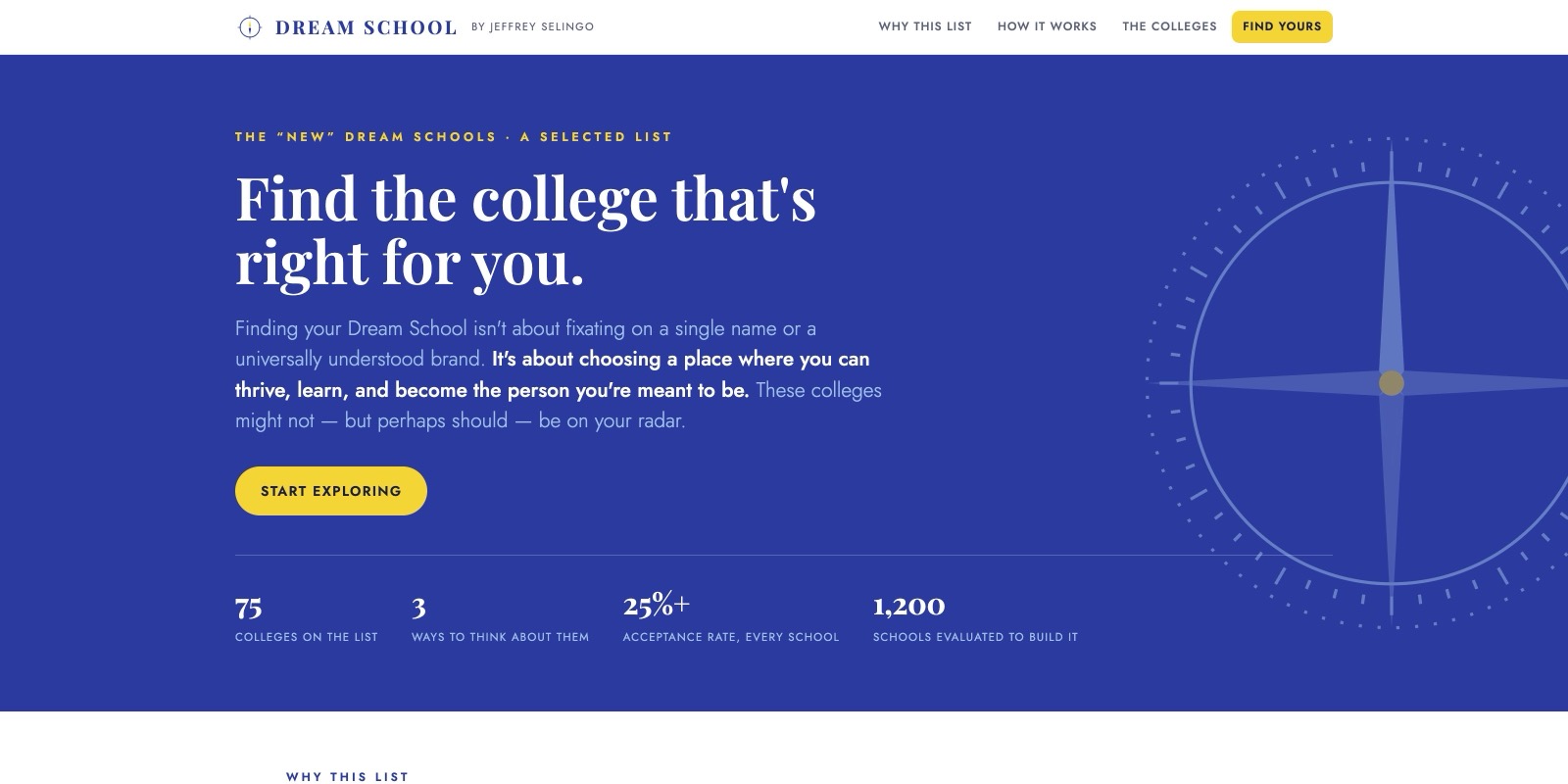
The appendix gives us an unusually tangible opportunity to test the Choice thesis quickly. Much of the underlying intellectual work already exists. The first objective is not revenue. The first objective is learning: Will families register? Will they return? Will they save schools? Will they share recommendations? Will they pay for additional utility? A simple MVP could test this through a landing page, a digital version of the appendix, an Instagram and social acquisition campaign, email capture, personalized recommendations, and premium upgrade testing. The result would be valuable regardless of outcome. If families engage, Selingo begins building a consumer intelligence platform. If they do not, the company gains valuable insight into what families actually need. The larger opportunity is not a college search tool. It is becoming the trusted translator between families and an increasingly complex education marketplace.
This is where I think there is a larger strategic opportunity worth exploring. I would not start by declaring a move into K-12. I would earn the right to move there through the family relationship. Dream School creates an authentic entry point because families do not experience education as separate sectors. They experience a journey. The questions begin long before college admissions: What skills will matter in an AI economy? What experiences prepare students for the future? How should families think about college readiness? What pathways exist beyond the traditional four-year model? How should students evaluate majors, careers and debt? Those questions connect directly to the intellectual territory you have already established through your books and reporting.
The broader K-12 market is interesting because it has many strong institutions and reporters, but there appears to be less national thought leadership that connects families, schools, technology, workforce, policy and the future of learning. This is where the Selingo model could eventually extend. The opportunity is not to become another education news organization. It is to become the trusted interpreter of how education connects to opportunity. The same forces reshaping higher education are increasingly shaping K-12: artificial intelligence, changing workforce demands, parent expectations, demographic shifts, technology adoption, public trust, funding pressure, questions about educational outcomes. There is also a commercial logic. Many of the organizations investing in education think across the full pipeline. Technology companies, employers and workforce organizations increasingly see K-12, higher education and career pathways as connected systems. Dream School creates the bridge.
Start with project-priced sprints, put points on the board, and test whether this becomes a much deeper operating partnership.
You asked me what a project-based engagement with me would look like and where I would start. I want to start with discrete sprints. Each sprint should have a clear scope, a price — on the order of $10K per sprint — deliverables, a cadence, and measurable outcomes. We should hold each other accountable and put points on the board. That gives two friends who have talked about building things together for years a disciplined way to establish a serious business relationship. We learn how we make decisions together. We learn how fast we can move. We learn where we sharpen each other and where we create friction. We create visible enterprise value at the same time.
Two-stage by design — because the 2026 edition is essentially done (Google sponsoring, out late September). Stage one (now): the launch playbook — pace the rollout instead of a single drop, make the signature charts shareable with sponsor attribution, add a predictions/unknowns section, prototype the one-click slide download. Stage two: build the 2027 operating system — proprietary data, visual identity, commercial architecture, yearlong franchises, SOHE Live.
Points on the board: A bigger 2026 launch moment; the 2027 revenue plan; data/IP roadmap; slide-download prototype.
Immediate work: Turn the appendix and methodology into a live product prototype; define data updates and licensing; test registration, saving, comparison, and membership; map counselor and school use cases.
Points on the board: A real consumer product and direct evidence about willingness to engage and pay.
Immediate work: Prototype two to three data franchises; define free/Pro/Executive boundaries; build the board-ready slide-download concept; create a data editorial calendar.
Points on the board: Evidence for paid professional intelligence and workflow utility.
Immediate work: Define the worldview map; evaluate Karin and other candidates; design the trust-transfer plan, economics, launch path, and performance measures.
Points on the board: The first franchise that expands Selingo Inc. through a voice other than Jeff.
You asked me the question directly yesterday (Aug 24): "Can you be reliable to me?" It deserves a written answer, because my own trust formula — the one I applied to Scott — applies to me too: trust = (credibility + reliability + intimacy) ÷ self-interest. My credibility you can judge from this report. My self-interest is on the table in this section, plainly. Intimacy we have twenty years of. Reliability is the variable — and we both named the history honestly: the deck I built for Chris on my own clock, the creative caves, the weeks this summer when I went dark. On your side: the ball-hog instinct, and the years of wondering whether making time for this would be worth it, or whether I'd run off to the next thing at the fifty-yard line.
So the contract is structural, not aspirational. Every sprint has a defined scope, a price, a deadline, and a named deliverable — reliability with a scoreboard. A standing weekly working session, on the calendar, so communication never depends on either of our moods. Cave protocol: when I go deep on a build, I say so in advance and name the re-emergence date — going dark is no longer ambiguous. And a kill rule: if either of us feels the fifty-yard-line problem coming, we say it in the weekly, not in a six-month silence. Your words: "If we could deliver on a couple of cool things, I'm more than happy to say let's do something bigger." That is the bet. The sprints are how I earn it.
I have also been thinking about what this means for me. I have spent much of my career building around talented people, ideas, media brands, audiences, revenue, and institutions. As I think about the next chapter of my own career — and the combination of societal impact and wealth creation I want from it — I increasingly believe I need to apply everything I know to a singular talent with the capacity to become the center of a much larger enterprise. I think you are that kind of talent. That is part of why this has become so interesting to me. I can see the company. I can see the impact. I can see the commercial opportunity. I can also see the amount of work required to turn the pieces into a system.
So I see the project work as a down payment on a deeper possibility. We start by building. We establish operating trust. We put real numbers and products on the board. We create accountability. We see whether our instincts compound. If that happens, I can imagine a much deeper role over time, potentially serving as President of Selingo Inc. I am intentionally leaving the structure undefined today. I want the possibility on the table because the ambition in this report eventually requires someone waking up every morning responsible for the value of the whole enterprise while you spend your time on the things only Jeff can do.
I see a natural division of labor developing. You own the judgment, signature relationships, voice, and trust transfer. I own architecture, productization, business model, incubation, cross-franchise coordination, and the operating discipline required to turn experiments into an institution. We should earn our way into that model through results.
| Jeff | Peter |
|---|---|
| Worldview and judgment | Architecture and prioritization |
| Signature relationships | Productization and business model |
| Talent ordination and audience trust | Talent system and franchise incubation |
| Signature content and public voice | Intelligence infrastructure and workflow utility |
| Presidential / board trust | Commercial architecture and partnerships |
| Stage presence and convening authority | Experimentation, measurement, and scaling discipline |
The opportunity outlined in this report is intentionally ambitious. The goal is not to launch everything at once. The goal is to identify the highest-leverage actions that begin turning existing assets into an integrated institution. The first 90 days should focus on learning, validation and building the connective tissue between what already exists.
The first step is aligning around the questions Selingo has earned the right to own. This means pressure-testing: What are the core forces reshaping education? Which questions should Selingo answer every year? Which areas have the strongest combination of expertise, access and market value? The output should be the intellectual framework that guides every product.
Before designing new products, understand the assets already available. Analyze: Next subscribers, newsletter engagement, webinar attendees, salon participants, Academy alumni, speaking audiences, LinkedIn reach, and institutional relationships. The goal is to understand who is already in the ecosystem and where the strongest opportunities exist.
Rather than attempting to build the entire platform, identify three experiments. Intelligence experiment: test a premium Selingo Intelligence product — a leadership transition tracker, AI adoption index or institutional intelligence brief. Community experiment: test a recurring leadership cohort — a quarterly presidential or trustee cohort built around Chatham House conversations. Choice experiment: test Dream School as a digital consumer product — an interactive college discovery tool supported by targeted acquisition. The objective is not scale. The objective is learning.
Using State of Higher Education as the map, identify the future Selingo bench. Which forces require dedicated expertise? Which people already have trusted audiences? Who could become franchise owners? Where should Selingo partner versus build internally? Karin is an important first test case, but the larger question is building a repeatable talent model.
The final step is beginning to design the institution we want to build. By the end of 90 days, we should have clarity on: the intelligence products, the community model, the consumer experiments, the talent strategy, the flagship gathering concept, and the revenue model.
The Bill Simmons of higher education remains useful shorthand. The opportunity I see is an institution built around a singular talent and a distinctive worldview, with proprietary intelligence, a real bench, professional products that help leaders make decisions, consumer products that help families navigate education, an annual report that shapes the agenda, and a gathering that defines the room.
The commercial models can span subscription, sponsorship, advisory, events, data, digital products, research partnerships, and talent economics. The addressable territory can eventually widen from higher education into the larger education-and-talent ecosystem.
You have already earned the position from which this can be built. You have the trust, relationships, audience, community, sponsor demand, author IP, data instincts, live formats, and first major annual franchise. The newest inputs make me more convinced because they show that many of the systems we want already exist in partial form: a five-year webinar library, repeat sponsors, a senior first-party audience, sponsor-funded research, data questions dating back years, and a salon community that is asking for deeper recurring connection.
On the whiteboard yesterday (Aug 24) I drew you two shapes. A bell curve — where the revenue sits today, centered on higher-ed B2B. And a barbell — institutions on one end, families and the workforce on the other, where the impact lives. The point was to reject both. The real picture is the one I didn't draw: a connected ecosystem in which Clarity, Community and Choice feed one another and everything drives to a single destination — you, as the Bill Simmons of American education. Education is the factory where American talent is made; that is how the country competes. Owning that story is what makes this an Allen & Co. for education — not just higher education.
And the capital moment is real, now: WME's Slow Creator Fund ($64M for "category-defining creators with deeply committed communities"), Shamrock looking hard at the space, U.S. News interested, the Chronicle for sale. As you said yesterday: "This is a moment I want to pounce… I need both expertise and money." The Doug Lederman lesson cuts the other way — give away too much equity too early and twenty-five years later your life hasn't changed. The discipline that squares it: build as if preparing for investment. Every chart with no lumps. Every franchise with a cadence. Every experiment with a number attached. Then capital becomes a choice, not a rescue.
I want to help you give all of that architecture — and build the company around it.
— Peter